ऑक्सीजन कंसंट्रेटर या सिलेंडर?
घर पर ऑक्सीजन के लिए कंसंट्रेटर और सिलेंडर में क्या अंतर है? उपयोग, बिजली बैकअप, सुरक्षा और डॉक्टर से पूछने वाले सवाल समझें।
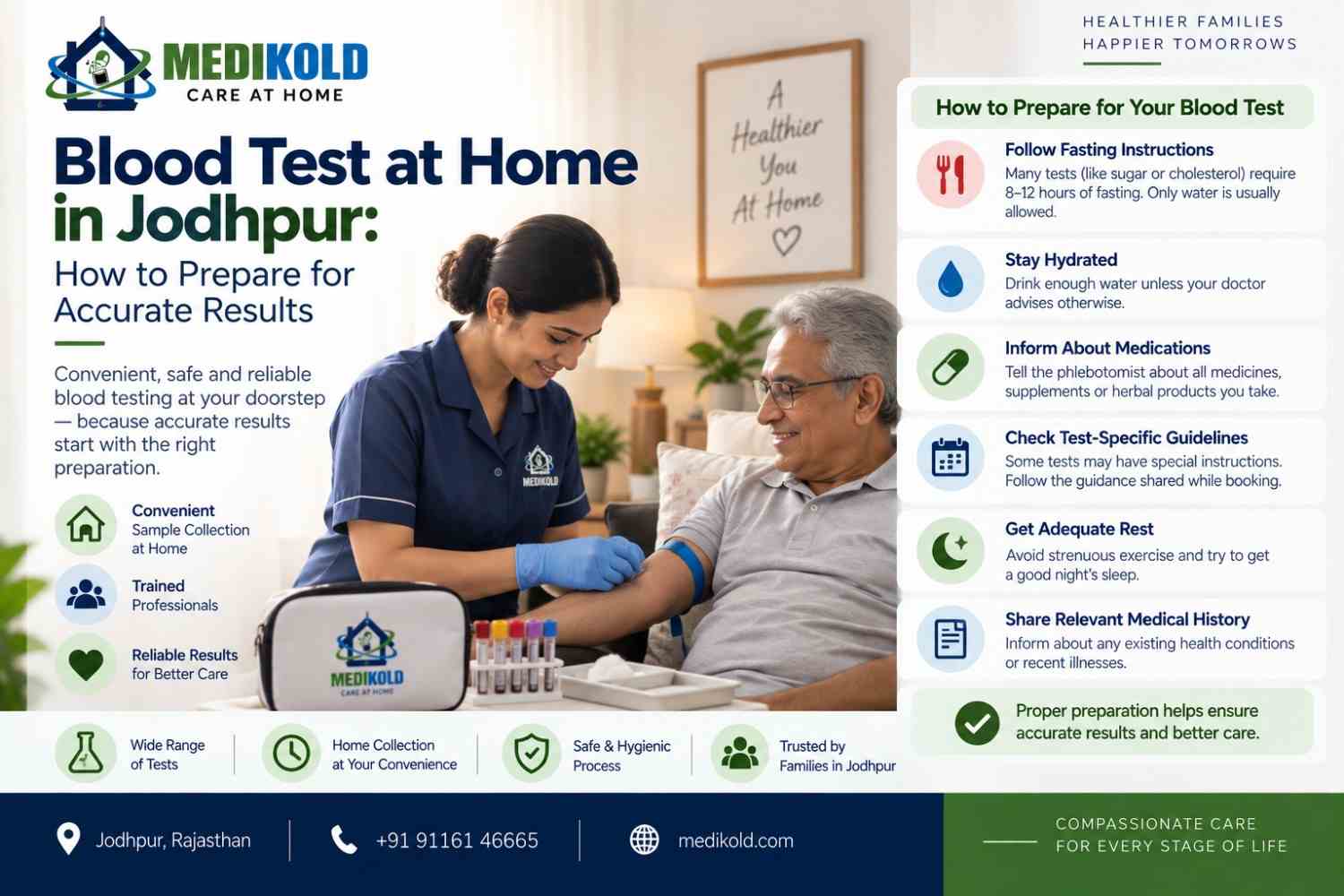
Simple preparation can make home blood-test collection smoother and help results be interpreted correctly.
Getting a blood test done at home has become a common choice for older adults, people recovering from illness, patients with limited mobility, and busy families who want to avoid a clinic or lab visit purely for sample collection. The convenience is real, but accurate, useful results still depend on proper preparation beforehand and correct interpretation afterward, not simply on having a phlebotomist arrive at the door.
A blood test at home should be treated with the same seriousness as one done in a hospital laboratory. The setting is different, but the preparation, sample handling, and clinical follow-up all matter just as much.
Many blood tests are sensitive to recent food intake, hydration, time of day, medicines, and physical activity. A fasting glucose or lipid profile taken shortly after a meal can produce misleading results, potentially leading to unnecessary concern or, just as problematic, a falsely reassuring number that hides a real issue. Getting preparation right the first time also avoids the inconvenience and delay of having to repeat a test.
Tests such as fasting blood glucose, lipid profile, and certain liver and kidney function panels typically require eight to twelve hours of fasting, usually overnight. Plain water is generally allowed, but tea, coffee, juice, and chewing gum are usually not, since they can affect results. Always confirm the exact fasting window with the ordering doctor or the lab, since requirements can vary slightly by test and by laboratory.
Many tests, including complete blood count, thyroid function, and several hormone panels, do not require fasting at all. Fasting unnecessarily before a non-fasting test provides no benefit and can be uncomfortable, particularly for elderly patients, diabetics, or children, so it is worth confirming rather than assuming a blanket fasting rule applies to every test ordered.
Certain tests, such as those checking drug levels or specific hormones, may require adjusting the timing of a medicine dose relative to sample collection. Never stop or delay a prescribed medicine without explicit instruction from the prescribing doctor, since doing so can affect both the test result and the patient's underlying condition.
Have the doctor's prescription or test list ready, along with identification if required by the lab. Keep any previous relevant reports available for comparison, particularly for tests being repeated to track a condition over time. If specific fasting or timing instructions were given, confirm exactly how long the fasting window has been observed when the collector arrives.
Choose a well-lit, comfortable space for the collection, ideally seated with the arm supported. Inform the phlebotomist about any known difficulty with blood draws, fear of needles, prior fainting during blood collection, or a preferred arm, so they can prepare appropriately rather than encountering these issues mid-procedure.
A trained phlebotomist should confirm the patient's identity and the tests ordered before beginning, use single-use sterile equipment, and label samples immediately and correctly. Ask questions if anything about the process feels unclear, and mention any current symptoms such as dizziness, nausea, or anxiety, since collection technique can sometimes be adjusted to make the experience more comfortable.
If a patient feels lightheaded, sweaty, or faint at any point, they should say so immediately rather than trying to push through it. A brief pause, lying down, or adjusting position can prevent a fall or a more significant reaction.
Some tests are sensitive to how quickly a sample reaches the laboratory and how it is transported. A reliable home collection service will have proper cold-chain handling where required, correct labelling, and a defined transport time to the laboratory. This is one of the reasons choosing an established, quality-controlled provider matters more than choosing the cheapest available option.
Do not interpret an abnormal or borderline result in isolation. Laboratory reference ranges are general guides, and a single number needs to be considered alongside the patient's symptoms, medical history, medicines, and previous results. A value slightly outside the reference range is not automatically a cause for alarm, and a value within range does not always rule out a problem if the clinical picture suggests otherwise.
Share results promptly with the ordering doctor rather than searching for interpretations independently. Significant or unexpected findings should prompt a proper clinical discussion, and in some cases repeat testing or additional investigation, rather than a decision made from the report alone.
Certain tests or clinical situations still require a laboratory or hospital visit, particularly when a sample needs immediate processing under specific conditions, when the patient's veins are difficult to access and specialised equipment may be needed, or when the test is part of an urgent diagnostic workup that also requires other same-day investigations. A good home collection service will be upfront when a lab or hospital visit is genuinely the better option.
Patients managing chronic conditions such as diabetes, thyroid disorders, or kidney disease often need periodic blood tests as part of routine monitoring. Explore blood tests at home in Jodhpur and our broader home lab testing services for coordinated, repeat testing without needing a fresh referral or facility visit each time.
For patients whose test results suggest a need for further assessment, a doctor home visit in Jodhpur can help review findings, adjust treatment, and decide on next steps without an additional trip out.
Confirm fasting requirements and duration with the doctor or lab. Keep the prescription, prior reports, and identification ready. Continue prescribed medicines unless specifically told otherwise. Choose a comfortable, well-lit space for collection. Mention any history of fainting or difficulty with blood draws in advance. Share results with the ordering doctor rather than interpreting them alone.
Book a Blood Test at Home in Jodhpur
Plain water is generally allowed during fasting, but always confirm with the specific instructions for your test, since requirements can vary slightly.
Only if your doctor specifically instructs you to. Most medicines should be continued as normal unless told otherwise.
Tell the phlebotomist immediately, remain seated or lie down if advised, and avoid standing up quickly afterward.
This varies by test, but many routine panels are available within twenty-four hours, while some specialised tests may take longer.
Yes, when performed by trained staff with proper sample handling and processed at an accredited laboratory, results are equivalent to those from an in-person visit.
Yes, many home collection services accommodate children, though very young children or those needing specialised paediatric collection may sometimes need a facility visit.
Inform the phlebotomist or lab before collection, since some tests may need to be rescheduled to avoid an inaccurate result.
Yes, most home collection services can draw for several tests in one visit, provided all requirements, such as fasting, are compatible across the requested tests.
Yes, mentioning any new or unusual symptoms to your doctor when reviewing results can help them interpret findings in the correct clinical context.
This article is for educational purposes and does not replace personalised medical advice. Please discuss your test results with a qualified doctor.
घर पर ऑक्सीजन के लिए कंसंट्रेटर और सिलेंडर में क्या अंतर है? उपयोग, बिजली बैकअप, सुरक्षा और डॉक्टर से पूछने वाले सवाल समझें।
12 या 24 घंटे की home nursing किस मरीज के लिए उचित है? Clinical जरूरत, रात की सुरक्षा, caregiver की भूमिका और discharge plan समझें।
“No acute bony injury” describes what was visible on an X-ray, not every possible cause of pain. Learn common report terms, when follow-up matters and which symptoms need urgent care.
Tests such as fasting blood glucose, lipid profile, and certain liver and kidney function panels typically require eight to twelve hours of fasting, usually overnight. Plain water is generally allowed, but tea, coffee, juice, and chewing gum are usually not, since they can affect results. Always confirm the exact fasting window with the ordering doctor or the lab, since requirements can vary slightly by test and by laboratory.
Many tests, including complete blood count, thyroid function, and several hormone panels, do not require fasting at all. Fasting unnecessarily before a non-fasting test provides no benefit and can be uncomfortable, particularly for elderly patients, diabetics, or children, so it is worth confirming rather than assuming a blanket fasting rule applies to every test ordered.
Certain tests, such as those checking drug levels or specific hormones, may require adjusting the timing of a medicine dose relative to sample collection. Never stop or delay a prescribed medicine without explicit instruction from the prescribing doctor, since doing so can affect both the test result and the patient's underlying condition.
Plain water is generally allowed during fasting, but always confirm with the specific instructions for your test, since requirements can vary slightly.
Only if your doctor specifically instructs you to. Most medicines should be continued as normal unless told otherwise.
Tell the phlebotomist immediately, remain seated or lie down if advised, and avoid standing up quickly afterward.
This varies by test, but many routine panels are available within twenty-four hours, while some specialised tests may take longer.
Yes, when performed by trained staff with proper sample handling and processed at an accredited laboratory, results are equivalent to those from an in-person visit.
Yes, many home collection services accommodate children, though very young children or those needing specialised paediatric collection may sometimes need a facility visit.
Inform the phlebotomist or lab before collection, since some tests may need to be rescheduled to avoid an inaccurate result.
Yes, most home collection services can draw for several tests in one visit, provided all requirements, such as fasting, are compatible across the requested tests.
Yes, mentioning any new or unusual symptoms to your doctor when reviewing results can help them interpret findings in the correct clinical context.
Stay updated with our latest medical news, insights, and exclusive health tips delivered straight to your inbox.