घर पर Oxygen कब लगानी चाहिए? जरूरी सावधानियां
घर पर oxygen कब जरूरी होती है, pulse oximeter reading कैसे समझें, और किन लक्षणों पर hospital जाना चाहिए।
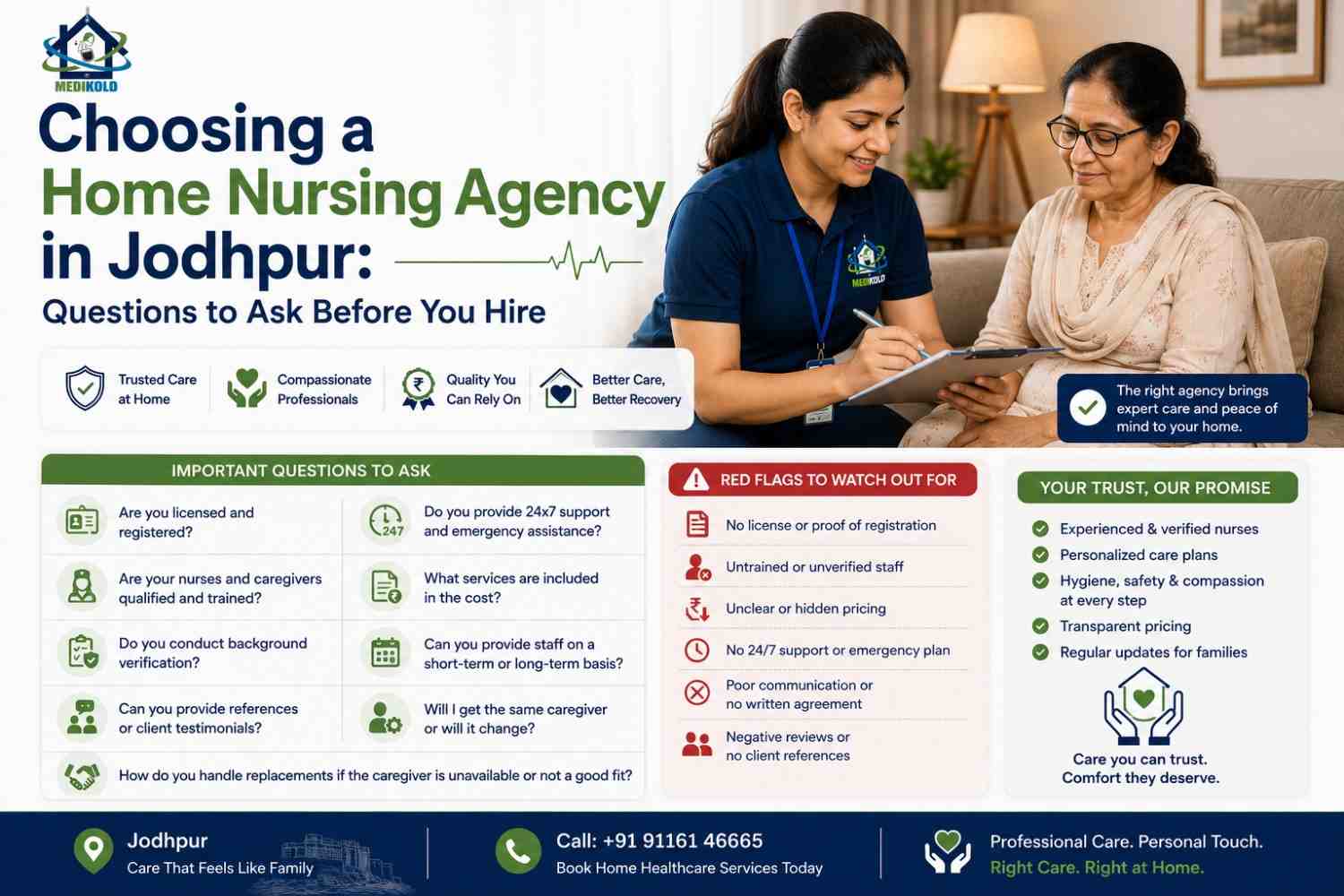
Hiring home nursing care for a family member is a significant decision. Here are the questions that actually reveal whether an agency is the right choice.
Bringing a qualified nurse into your own home to care for a family member is a decision that combines medical, practical, financial, and deeply personal considerations, all weighed together carefully at once, often during an already stressful and uncertain time. With home nursing services becoming increasingly and more widely available across Jodhpur in recent years, quality and reliability still vary considerably between different providers, and knowing precisely what to ask before committing makes a genuinely real difference to the eventual outcome.
Confirm that nursing staff hold recognised nursing qualifications and, where relevant to your specific care needs, additional training, wound care, elderly care, post-surgical care, or condition-specific experience like stroke or cancer care.
Background verification, reference checks, and confirmation of credentials should be standard practice for any reputable agency, not something families need to independently verify themselves after the fact.
For more complex medical needs, having physician oversight built into the care plan, not just nursing care operating independently, matters considerably for catching and responding to changes in condition appropriately.
A good agency actively communicates with the patient's treating physicians and specialists, rather than operating as a disconnected service that families need to manually relay information between.
Illness, emergencies, and scheduling conflicts happen. A reliable agency has a clear backup system to maintain continuity of care rather than leaving a gap in coverage.
Regular updates, not just communication when something goes wrong, help families stay genuinely informed and involved in their family member's care.
Understanding exactly what happens, who is called, what immediate steps are taken, if a medical emergency occurs during a nursing shift, should be clear before care begins, not figured out during a crisis.
Get a clear, specific breakdown of what's covered, medication administration, wound care, mobility assistance, vital sign monitoring, versus what would require an additional arrangement or separate service.
Understand whether pricing is hourly, per-shift, or per-package, and what factors might cause costs to change, so there are no surprises partway through an extended care period.
Many families benefit from an initial shorter arrangement to assess fit and quality before committing to longer-term care, and a confident, quality agency should be comfortable with this approach.
Beyond the specific questions, pay attention to how the agency communicates with you during the initial conversations, are they patient with questions, clear in their explanations, and transparent about both capabilities and limitations. These early interactions often reflect how the ongoing relationship will actually feel.
Our home nursing services in Jodhpur are built around physician-supervised, coordinated care specifically because families deserve clear, honest answers to exactly these questions before making a decision that affects a loved one's wellbeing. Our related article on home nursing services covers what a well-run service typically includes in more depth.
Alongside the questions worth asking, certain responses should give a family pause. Vague or evasive answers about qualifications and vetting, reluctance to put pricing or service inclusions in writing, an inability to describe a clear emergency escalation process, or pressure to commit to a long-term contract before any trial period, are all reasonable reasons to look elsewhere. A confident, established agency should be comfortable with thorough questioning; hesitation or defensiveness in response to reasonable questions is itself useful information.
Once care begins, the quality of an agency often shows most clearly in the ordinary, day-to-day communication rather than in any single dramatic moment. A nurse who documents observations clearly, a coordinator who follows up proactively rather than only when contacted, and a consistent point of contact who actually knows the patient's situation rather than starting from scratch each call, are all signs of a well-run service. These details matter more over months of ongoing care than they might seem to during the initial hiring decision.
Yes, this is a sensible step, though price should be weighed alongside qualifications, oversight, and communication quality rather than being the only deciding factor.
Many agencies, including ours, welcome this, since it helps establish comfort and rapport between the patient, family, and nurse before care formally starts.
Yes, a clear written agreement covering services, pricing, and terms is a reasonable expectation and protects both the family and the agency from misunderstandings later.
A written care plan, clear pricing, and documented nursing notes after each visit are reasonable baseline expectations, giving the family a clear record of the care being provided.
Yes, continuity of care is valuable, particularly for complex or long-term needs, and a good agency will generally try to maintain the same primary nurse wherever possible.
For anything beyond very basic support, physician oversight is valuable, since it allows changes in condition to be assessed and acted on medically, not just observed by nursing staff alone.
This varies by provider and urgency, but a responsive agency should be able to begin care within a day or two for most situations, faster for urgent needs.
Yes, and it should be, a good agency will reassess and adjust the care plan as needs evolve rather than providing a fixed, unchanging service regardless of the patient's condition.
Asking for references, checking how long the agency has operated, and starting with a shorter trial period are all reasonable ways to assess quality before a longer-term commitment.
This depends on the provider and the patient's needs; many agencies offer both scheduled visits and, where clinically necessary, more continuous coverage.
A reputable agency should have a straightforward process for reassignment or addressing concerns, and this is worth clarifying as part of your initial questions before care begins.
This article is for educational purposes and does not replace personalized medical advice. Please consult a qualified physician before making changes to your treatment, medication, or health screening plan.
घर पर oxygen कब जरूरी होती है, pulse oximeter reading कैसे समझें, और किन लक्षणों पर hospital जाना चाहिए।
घर पर नेबुलाइज़र के सुरक्षित उपयोग, सफाई, दवा संबंधी सावधानी और कब तुरंत अस्पताल जाना चाहिए, इसकी आसान जानकारी।
घर पर ऑक्सीजन के लिए कंसंट्रेटर और सिलेंडर में क्या अंतर है? उपयोग, बिजली बैकअप, सुरक्षा और डॉक्टर से पूछने वाले सवाल समझें।
Confirm that nursing staff hold recognised nursing qualifications and, where relevant to your specific care needs, additional training, wound care, elderly care, post-surgical care, or condition-specific experience like stroke or cancer care.
Background verification, reference checks, and confirmation of credentials should be standard practice for any reputable agency, not something families need to independently verify themselves after the fact.
For more complex medical needs, having physician oversight built into the care plan, not just nursing care operating independently, matters considerably for catching and responding to changes in condition appropriately.
A good agency actively communicates with the patient's treating physicians and specialists, rather than operating as a disconnected service that families need to manually relay information between.
Illness, emergencies, and scheduling conflicts happen. A reliable agency has a clear backup system to maintain continuity of care rather than leaving a gap in coverage.
Regular updates, not just communication when something goes wrong, help families stay genuinely informed and involved in their family member's care.
Understanding exactly what happens, who is called, what immediate steps are taken, if a medical emergency occurs during a nursing shift, should be clear before care begins, not figured out during a crisis.
Get a clear, specific breakdown of what's covered, medication administration, wound care, mobility assistance, vital sign monitoring, versus what would require an additional arrangement or separate service.
Understand whether pricing is hourly, per-shift, or per-package, and what factors might cause costs to change, so there are no surprises partway through an extended care period.
Many families benefit from an initial shorter arrangement to assess fit and quality before committing to longer-term care, and a confident, quality agency should be comfortable with this approach.
Yes, this is a sensible step, though price should be weighed alongside qualifications, oversight, and communication quality rather than being the only deciding factor.
Many agencies, including ours, welcome this, since it helps establish comfort and rapport between the patient, family, and nurse before care formally starts.
Yes, a clear written agreement covering services, pricing, and terms is a reasonable expectation and protects both the family and the agency from misunderstandings later.
A written care plan, clear pricing, and documented nursing notes after each visit are reasonable baseline expectations, giving the family a clear record of the care being provided.
Yes, continuity of care is valuable, particularly for complex or long-term needs, and a good agency will generally try to maintain the same primary nurse wherever possible.
For anything beyond very basic support, physician oversight is valuable, since it allows changes in condition to be assessed and acted on medically, not just observed by nursing staff alone.
This varies by provider and urgency, but a responsive agency should be able to begin care within a day or two for most situations, faster for urgent needs.
Yes, and it should be, a good agency will reassess and adjust the care plan as needs evolve rather than providing a fixed, unchanging service regardless of the patient's condition.
Asking for references, checking how long the agency has operated, and starting with a shorter trial period are all reasonable ways to assess quality before a longer-term commitment.
This depends on the provider and the patient's needs; many agencies offer both scheduled visits and, where clinically necessary, more continuous coverage.
A reputable agency should have a straightforward process for reassignment or addressing concerns, and this is worth clarifying as part of your initial questions before care begins.
Stay updated with our latest medical news, insights, and exclusive health tips delivered straight to your inbox.