12 या 24 घंटे की Home Nursing: किसे क्या चाहिए?
12 या 24 घंटे की home nursing किस मरीज के लिए उचित है? Clinical जरूरत, रात की सुरक्षा, caregiver की भूमिका और discharge plan समझें।
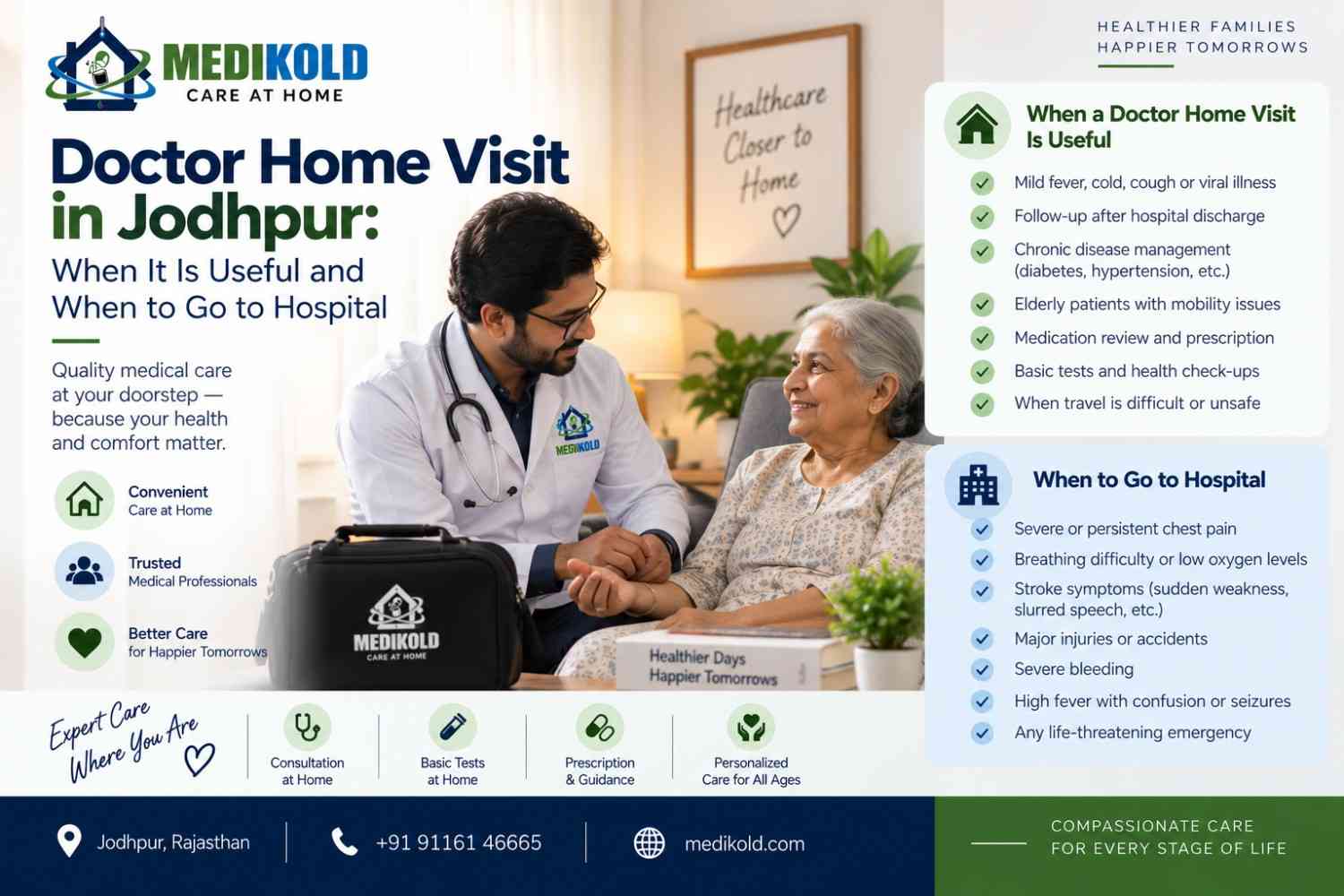
A doctor visit at home can support selected patients, but some symptoms need emergency hospital care without delay.
Deciding whether a situation calls for a doctor's home visit or a trip to the hospital is a judgment call families often have to make quickly, sometimes while worried and uncertain. A home visit can be genuinely useful for many non-emergency situations, but it is not a substitute for emergency or hospital-based care when symptoms point to something more serious. Understanding the difference in advance, before a decision has to be made under pressure, makes it considerably easier to choose correctly when the moment actually arrives.
This is not a decision that should be made by guesswork alone. A good home-care provider will be upfront about what can safely be assessed at home and will actively direct a family toward hospital care when that is the more appropriate option, rather than trying to manage every situation on-site regardless of risk.
For elderly patients who find travel physically difficult or disorienting, a home visit avoids the added risk of falls, exhaustion, or confusion that a clinic trip can create, particularly for routine or follow-up assessments that do not require hospital equipment.
After a hospital stay, a home visit can review recovery progress, check the surgical site or general condition, reconcile medicines, and catch early problems before they become serious, without requiring the patient to travel again so soon after discharge.
Patients managing stable diabetes, hypertension, or similar long-term conditions often only need periodic review, medicine adjustment, and basic monitoring, all of which a home visit can typically cover without the burden of a clinic visit.
Fever, minor infections, mild respiratory symptoms without breathing difficulty, and similar everyday illnesses can often be assessed safely and effectively at home, with the doctor determining whether further tests, treatment, or hospital referral is needed.
For immunocompromised patients, avoiding unnecessary exposure to a hospital or clinic waiting room is a genuine safety consideration when the situation does not clinically require hospital-level care.
Chest pain, severe or sudden breathlessness, signs of stroke such as facial drooping or slurred speech, major bleeding, seizures, loss of consciousness, or a severe allergic reaction all require emergency hospital care immediately. A home visit cannot provide the diagnostic and emergency response capability these situations need.
Situations that likely require imaging, laboratory testing beyond a basic home sample, surgical assessment, or continuous monitoring need a hospital or clinical facility rather than a home consultation alone.
When a patient's condition is deteriorating quickly, or when the cause of symptoms is genuinely unclear, the more comprehensive assessment capability of a hospital is the safer choice until the picture becomes clearer.
Severe, uncontrolled pain, a significant injury, or high fever in an infant, elderly patient, or someone with a serious underlying condition generally warrants prompt hospital evaluation rather than waiting for a scheduled home visit.
A structured home visit usually includes a clinical history review, physical examination appropriate to the presenting concern, basic vital sign checks, and a decision about whether further tests, treatment, or referral is needed. Having the patient's prior reports, current medicine list, allergies, and a clear description of symptoms ready in advance helps the visiting doctor make a more accurate assessment in a single visit.
Our doctor home visit service in Jodhpur is built around this kind of structured assessment, with clear escalation to hospital care whenever the clinical picture calls for it, rather than attempting to manage every case at home regardless of appropriateness.
Have a clear, written timeline of when symptoms started and how they have changed. Gather current medicines, including dosages and timing, any known allergies, recent hospital discharge summaries if relevant, and previous test reports. If possible, take note of vital signs such as temperature, if a thermometer is available, since this information helps the doctor assess urgency more accurately even before arrival.
Choose a quiet, well-lit space for the examination, and ensure a family member who knows the patient's history well is present, particularly for elderly patients or those who may have difficulty communicating symptoms clearly themselves.
Many conditions assessed during a home visit benefit from follow-up blood work or monitoring. Review home lab testing services in Jodhpur for sample collection that can be arranged without a separate facility visit, with results reviewed by the same clinical team managing the case.
For patients who need ongoing support beyond a single consultation, such as wound care, injections, or regular monitoring, home nursing services can be coordinated alongside doctor visits to provide continuous, rather than one-off, care.
When uncertain, three questions can clarify the decision quickly. Is the symptom sudden, severe, or rapidly worsening, or is it mild and stable? Does the situation likely require equipment or intervention only available at a hospital, such as imaging or emergency treatment? And is there already a known, stable diagnosis being monitored, or is this a new and unclear problem? Leaning toward hospital care whenever there is genuine uncertainty is almost always the safer choice.
A home visit that reveals a more serious problem than initially expected should lead directly to hospital referral, and a good doctor will make that call promptly rather than trying to manage a situation that has moved beyond what a home assessment can safely handle. Families should never feel that starting with a home visit was the wrong decision if it leads to timely hospital referral; recognising when a higher level of care is needed is exactly what responsible clinical judgment looks like.
For non-emergency planning, families can also contact MediKold to discuss whether a home visit, home nursing, or hospital coordination best fits a specific situation.
Book a Doctor Home Visit in Jodhpur
Yes, a qualified doctor can assess the patient and prescribe medication when clinically appropriate, in the same way as during a clinic consultation.
Yes, home sample collection can often be arranged alongside or following a home visit, with results shared with the same clinical team.
It can be, for many common childhood illnesses, though very high fevers, difficulty breathing, or a lethargic, unresponsive child should prompt urgent hospital evaluation instead.
The doctor will advise immediate hospital referral, and in some cases can help coordinate transport or communicate directly with the receiving facility.
This depends on availability and urgency, but a responsive service should be able to arrange a visit within a few hours for most non-emergency situations.
Yes, this is one of the most common and appropriate uses of a home visit, particularly when travel is difficult during early recovery.
Yes. Chest pain, severe breathlessness, stroke symptoms, major bleeding, or loss of consciousness always require emergency services, not a scheduled home visit.
Not always. Some conditions require hospital-based tests, specialist review, or equipment that a home visit cannot replace, so it typically complements rather than replaces hospital follow-up.
This article is for educational purposes and does not replace personalised medical advice. In a medical emergency, contact emergency services or go to the nearest hospital immediately.
12 या 24 घंटे की home nursing किस मरीज के लिए उचित है? Clinical जरूरत, रात की सुरक्षा, caregiver की भूमिका और discharge plan समझें।
“No acute bony injury” describes what was visible on an X-ray, not every possible cause of pain. Learn common report terms, when follow-up matters and which symptoms need urgent care.
Bedridden patient के लिए trained nurse और caregiver की भूमिका, skill, daily tasks, red flags और सही home-care plan चुनने का practical comparison।
For elderly patients who find travel physically difficult or disorienting, a home visit avoids the added risk of falls, exhaustion, or confusion that a clinic trip can create, particularly for routine or follow-up assessments that do not require hospital equipment.
After a hospital stay, a home visit can review recovery progress, check the surgical site or general condition, reconcile medicines, and catch early problems before they become serious, without requiring the patient to travel again so soon after discharge.
Patients managing stable diabetes, hypertension, or similar long-term conditions often only need periodic review, medicine adjustment, and basic monitoring, all of which a home visit can typically cover without the burden of a clinic visit.
Fever, minor infections, mild respiratory symptoms without breathing difficulty, and similar everyday illnesses can often be assessed safely and effectively at home, with the doctor determining whether further tests, treatment, or hospital referral is needed.
For immunocompromised patients, avoiding unnecessary exposure to a hospital or clinic waiting room is a genuine safety consideration when the situation does not clinically require hospital-level care.
Chest pain, severe or sudden breathlessness, signs of stroke such as facial drooping or slurred speech, major bleeding, seizures, loss of consciousness, or a severe allergic reaction all require emergency hospital care immediately. A home visit cannot provide the diagnostic and emergency response capability these situations need.
Situations that likely require imaging, laboratory testing beyond a basic home sample, surgical assessment, or continuous monitoring need a hospital or clinical facility rather than a home consultation alone.
When a patient's condition is deteriorating quickly, or when the cause of symptoms is genuinely unclear, the more comprehensive assessment capability of a hospital is the safer choice until the picture becomes clearer.
Severe, uncontrolled pain, a significant injury, or high fever in an infant, elderly patient, or someone with a serious underlying condition generally warrants prompt hospital evaluation rather than waiting for a scheduled home visit.
Yes, a qualified doctor can assess the patient and prescribe medication when clinically appropriate, in the same way as during a clinic consultation.
Yes, home sample collection can often be arranged alongside or following a home visit, with results shared with the same clinical team.
It can be, for many common childhood illnesses, though very high fevers, difficulty breathing, or a lethargic, unresponsive child should prompt urgent hospital evaluation instead.
The doctor will advise immediate hospital referral, and in some cases can help coordinate transport or communicate directly with the receiving facility.
This depends on availability and urgency, but a responsive service should be able to arrange a visit within a few hours for most non-emergency situations.
Yes, this is one of the most common and appropriate uses of a home visit, particularly when travel is difficult during early recovery.
Yes. Chest pain, severe breathlessness, stroke symptoms, major bleeding, or loss of consciousness always require emergency services, not a scheduled home visit.
Not always. Some conditions require hospital-based tests, specialist review, or equipment that a home visit cannot replace, so it typically complements rather than replaces hospital follow-up.
Stay updated with our latest medical news, insights, and exclusive health tips delivered straight to your inbox.