Feeding Tube After Stroke
When a feeding tube may be needed after stroke, what families should arrange before discharge, and home-care warning signs.
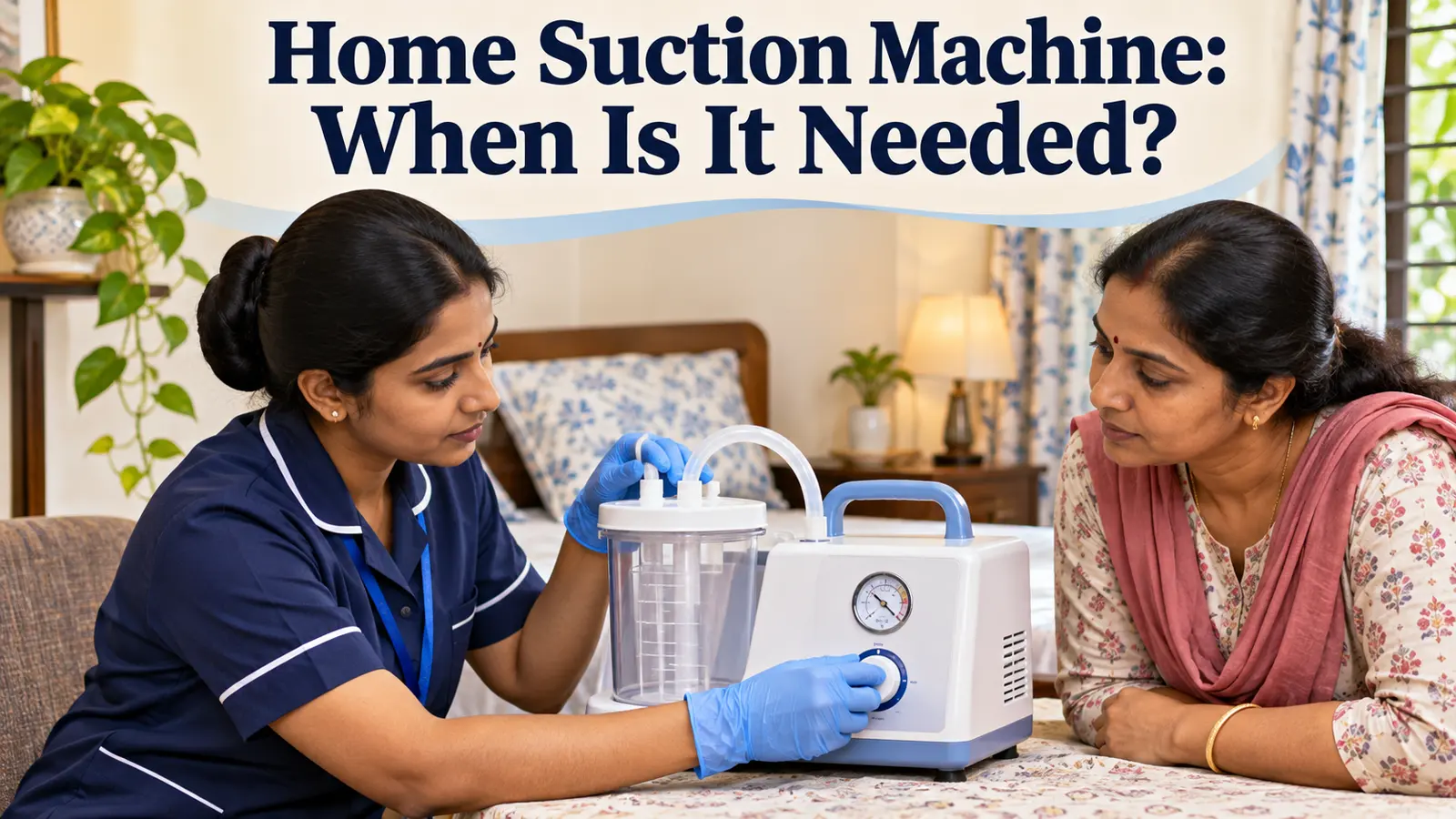
When is a home suction machine needed? Learn about oral versus airway suction, caregiver training, supplies and emergency planning.
A home suction machine removes secretions when a person cannot clear them safely by swallowing or coughing. Families may hear about one during discharge planning after a stroke, neurological illness, tracheostomy or prolonged hospital stay. It is not an item that every bedridden patient needs, and buying a machine without training can create risk. The clinical team should decide the reason for suction, the route, the equipment and who is competent to use it.
This English-language guide focuses on the decision to arrange suction at home, equipment planning and warning signs. Our tracheostomy care guide addresses airway care for people with a tracheostomy. This article also covers oral secretion management in people without one. It does not teach a suction procedure or specify settings, because those details must come from hands-on patient-specific training.
Saliva and mucus normally leave the mouth and airway through swallowing and coughing. Some illnesses weaken those functions. Secretions may collect in the mouth, cause drooling, interfere with breathing or create distress. A suction device can remove material when a clinician has determined that it is appropriate. It does not treat the underlying reason secretions are accumulating.
The Cambridge University Hospitals home-suction guide describes oral suction as a way to manage secretions when swallowing and cough are less effective. Different routes have different risks. Oral suction is not the same as suction through a tracheostomy or into the nose. The route should be written clearly in the care plan.
Possible candidates include people with neurological disease who cannot clear saliva, some patients after stroke, and people with a tracheostomy who have difficulty clearing mucus. Some patients with advanced illness may use oral suction for comfort. The need depends on secretion amount, ability to cough or swallow, breathing status and goals of care. A diagnosis alone does not automatically create a suction requirement.
Ask the treating clinician what they observed in hospital. Was suction required repeatedly? What other measures were tried? Is the problem likely temporary or ongoing? If a patient can manage secretions without suction, a machine may add unnecessary complexity. The decision should be revisited as the patient's condition changes.
Oral suction removes visible secretions from the mouth with a suitable attachment. Nasopharyngeal or tracheostomy suction goes into more sensitive areas and has additional risks. A caregiver trained for one route should not assume competence for another. The NHS carer guide stresses that training is needed before use.
The written plan should state exactly where suction may be applied, what equipment and attachments are supplied, and what signs indicate a need. It should also state when not to attempt suction and when to seek help. A generic instruction to “suction as required” leaves too much uncertainty for a new caregiver.
Not necessarily. Routine suction at fixed intervals without a clinical reason can cause discomfort or tissue injury. A clinical guideline on oral-cavity secretion management advises assessing the cause of secretion buildup and not using routine scheduled suction without indication. The patient's own plan may include specific observations or times, but these should be explained by the treating team.
Families should not use the machine just because it is present. Conversely, if the patient is struggling to breathe and cannot clear secretions, delaying an individualized emergency step can be dangerous. Training should make the decision clear enough for the caregiver to act safely and know when to call for clinical support.
The hospital team should identify the device model, power source, backup plan, collection container, tubing and compatible attachments. They should demonstrate operation, cleaning, replacement of supplies and what to do if the machine fails. A caregiver expected to use it should practise under supervision and be assessed. If the patient needs frequent suction or has a complex airway, professional nursing support may be required.
Write down the clinical indications, limits, emergency contacts and follow-up date. Ask who supplies consumables and how quickly a replacement machine can be obtained. Our hospital discharge equipment guide helps families plan the whole home setup. A suction machine is only one part of that plan.
Suction can cause discomfort, bleeding, injury to mouth or airway tissue, changes in breathing or infection if equipment is poorly handled. An incorrect attachment or setting can increase risk. Repeated suction may dry or irritate tissue. A machine that fails during a critical episode creates a different hazard. These are reasons for training and maintenance, not reasons to avoid a needed intervention.
Tell the care team about blood in secretions, new pain, repeated coughing or a change from the patient's usual breathing. Do not respond by increasing suction strength on your own. If the patient is blue, unconscious or in severe respiratory distress, call emergency services and follow the patient's emergency plan.
Follow the manufacturer's instructions and the discharge team's infection-control plan. Collection containers and tubing may have different cleaning or replacement rules. Label any patient-specific equipment and store it cleanly. Keep spare compatible supplies available before they run out. A family should know how to check that the device is ready without using it on the patient.
If the machine is powered by electricity, confirm whether it has a battery and how long it lasts. Ask about outages common in your area and identify a backup route. Do not use an unsafe extension-cord arrangement. A broken or visibly contaminated device should be assessed before reuse.
Depending on the patient's condition, the team may address positioning, hydration, mouth care, swallowing rehabilitation or medicines. These measures are not universal substitutes for suction, but they can influence secretion burden and comfort. A clinician should consider the reason secretions are building up rather than treating the machine as the whole solution.
For a stroke survivor, swallowing assessment and feeding decisions are separate but related. Our feeding tube after stroke guide explains why unsafe swallowing needs a coordinated plan. A feeding tube does not eliminate saliva or aspiration risk, so families should still follow the oral-care and airway instructions given at discharge.
Review after a readmission, infection, tube change, change in neurological function or new difficulty managing secretions. If suction becomes much more frequent than usual, contact the treating team. The patient may need an assessment for infection, dehydration, airway changes or another issue. If suction is rarely needed over time, the team can decide whether the equipment remains necessary.
Keep a simple record of use and symptoms if the clinician requests it. The goal is to identify change, not to create paperwork for its own sake. A trained nurse can help families interpret patterns and communicate them to the prescriber.
Ask whether the assigned home nurse has experience with the patient's specific suction route and equipment. Confirm training, emergency response and who supervises care. Family members should still know the warning signs and contacts. Nursing support cannot compensate for a missing written plan or incompatible supplies.
Medikold's home nursing guide describes questions to ask before arranging care. If the patient also needs oxygen or a ventilator, the level of support may be higher. Tell the hospital team what the family can realistically manage before discharge.
No. The need depends on whether secretions cannot be cleared safely and on the patient's clinical plan.
Only after hands-on training and approval for the specific patient and suction route.
Not as a universal rule. It should follow the patient's prescribed indications and assessment.
No. The route, equipment and risks differ. Training for one does not automatically cover the other.
Follow the written backup and emergency plan, contact the supplier and clinical team, and seek urgent help if breathing is compromised.
Call for severe breathing difficulty, blue colour, reduced consciousness or another emergency sign in the patient's plan.
When a feeding tube may be needed after stroke, what families should arrange before discharge, and home-care warning signs.
बुजुर्गों के लिए कौन से blood tests कब जरूरी हैं? CBC, sugar, kidney और दवा monitoring को डॉक्टर कैसे तय करते हैं।
A Jodhpur family guide to planning mobility, oxygen, bed, feeding and monitoring equipment before hospital discharge.
Stay updated with our latest medical news, insights, and exclusive health tips delivered straight to your inbox.