ऑक्सीजन कंसंट्रेटर या सिलेंडर?
घर पर ऑक्सीजन के लिए कंसंट्रेटर और सिलेंडर में क्या अंतर है? उपयोग, बिजली बैकअप, सुरक्षा और डॉक्टर से पूछने वाले सवाल समझें।
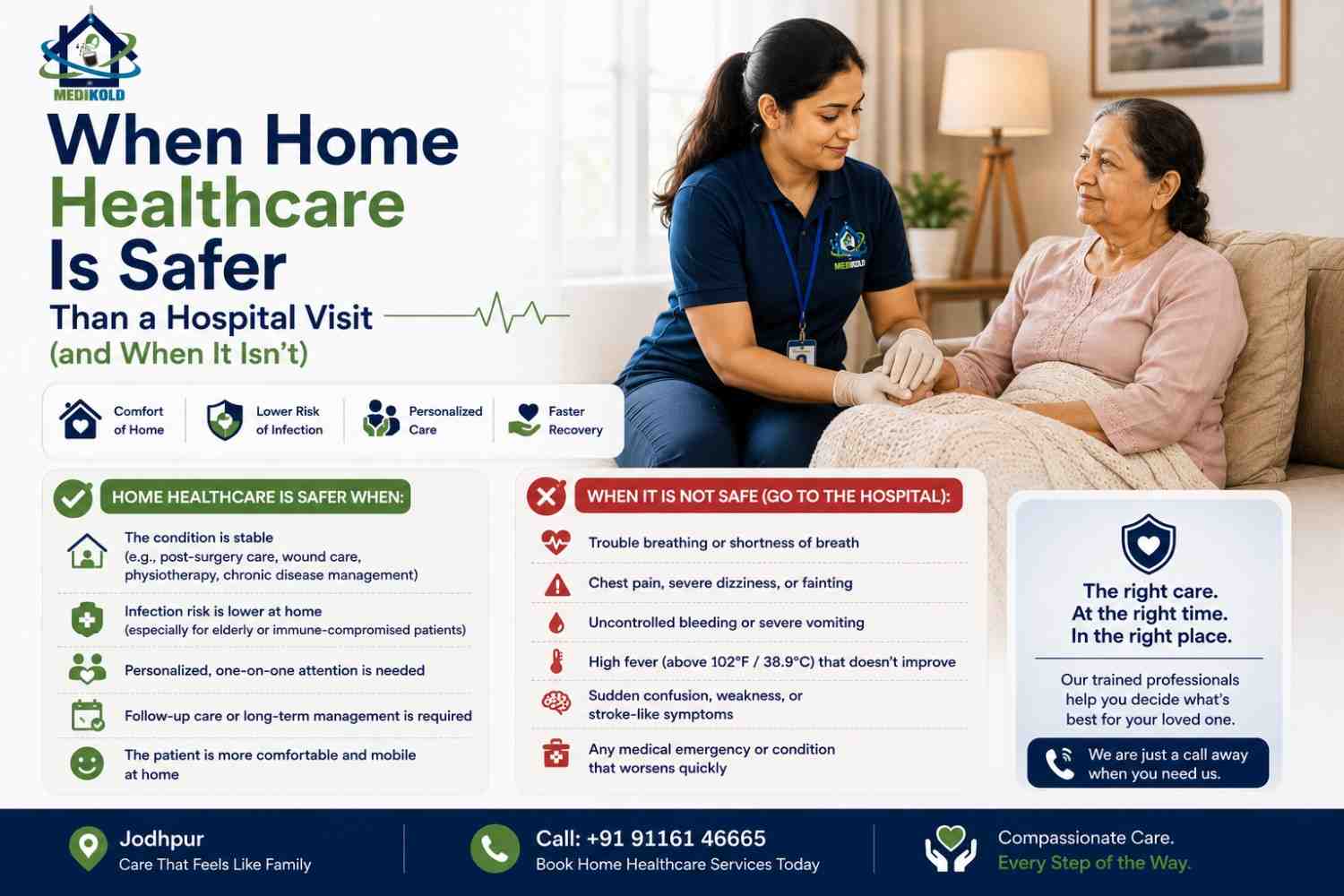
Choosing between home healthcare and a hospital visit isn't about which is generally better, it's about which fits the specific situation. Here's how to think it through.
Home healthcare has grown considerably as an option in Jodhpur and across India, and for good reason: it's often more comfortable, reduces exposure to hospital-acquired infections, and can be more cost-effective for many kinds of ongoing care. But it isn't universally the right choice, and understanding the difference matters, since choosing incorrectly in either direction carries real risk.
Regular blood pressure checks, diabetes monitoring, and medication management for stable chronic conditions can generally be handled safely and more conveniently at home, without repeated trips to a hospital or clinic purely for routine monitoring.
For surgeries where the acute risk period has passed and recovery is progressing as expected, wound care, physiotherapy, and general monitoring at home, covered in our related article on home injection services, is often more comfortable and equally safe compared to repeated hospital visits.
For elderly patients, particularly those with mobility challenges, the physical and logistical burden of hospital visits for routine care can itself carry risk, falls, exhaustion, disorientation from an unfamiliar environment, that home-based care avoids entirely.
For immunocompromised patients, whether from cancer treatment, certain medications, or other conditions, avoiding unnecessary exposure to a hospital environment, where infection risk is inherently higher, is a genuine safety consideration in favour of home-based care where clinically appropriate.
Many patients and families prefer, and benefit from, the comfort and familiarity of home during palliative or end-of-life care, when medically appropriate and properly supported.
Chest pain, difficulty breathing, sudden severe headache, signs of stroke, significant bleeding, or loss of consciousness always warrant emergency hospital care, not a home visit, given the need for immediate diagnostic capability and emergency intervention that simply isn't available at home.
Situations needing CT scans, MRIs, surgical intervention, or other hospital-based diagnostic and treatment capability obviously require the hospital setting, regardless of how stable the patient might otherwise appear.
When a patient's condition is actively deteriorating, or when the underlying cause of symptoms isn't yet clear, the more comprehensive monitoring and diagnostic capability of a hospital setting is generally the safer choice until the picture becomes clearer.
The immediate post-operative period following major surgery, where complications are more likely and often require rapid intervention, typically needs hospital-level monitoring before transitioning to home-based recovery care.
The most important principle is that this decision shouldn't be made in isolation by a worried family without medical input. A good home healthcare provider will be upfront about the limits of what can safely be managed at home, and will actively direct patients to hospital care when that's the more appropriate choice, rather than trying to keep every case at home regardless of clinical appropriateness. Our home healthcare team in Jodhpur works this way deliberately, treating home care and hospital care as complementary parts of a coordinated system rather than competing options.
When a family is uncertain, three questions tend to clarify the decision quickly. First, is the patient's condition stable and predictable, or is it changing rapidly and unpredictably? Second, does the situation require diagnostic equipment or intervention only available in a hospital, or is it primarily about monitoring, medication, and supportive care? Third, is there a clear, agreed plan for what happens if things change, so a decision made today doesn't become the wrong decision by tomorrow without anyone noticing? Working through these three questions with a physician, rather than defaulting to whichever option feels most familiar or convenient in the moment, generally leads to a safer and more appropriate choice.
It's worth normalising the fact that a decision to manage something at home doesn't have to be final. If a patient's condition changes, or if home-based monitoring reveals something more concerning than initially expected, moving to hospital care at that point reflects good clinical judgment, not a mistake in the original decision. Families sometimes hesitate to reconsider once a home care arrangement is underway, worried it means the earlier choice was wrong; in reality, adjusting the care setting as the clinical picture evolves is exactly what responsible, ongoing care looks like.
Discuss the Right Care Setting for Your Situation
No, clinical stability and specific care needs matter far more than age alone in determining whether home care is the right setting.
A good provider offers phone-based guidance during urgent situations to help families make a quick, informed decision rather than facing that choice entirely alone.
No, home care can be coordinated alongside specialist visits when needed, functioning as a complement to specialist care rather than a substitute for it.
Yes, many families use home nursing support for post-natal recovery and newborn care, particularly in the first few weeks, when both mother and baby benefit from professional support without hospital travel.
Many home healthcare services can arrange home sample collection for lab tests, though imaging like X-rays or scans generally still requires a facility visit or a mobile imaging service where available.
Often, particularly for ongoing or routine care, but cost shouldn't be the only factor. Clinical appropriateness should always take priority over cost when deciding between home and hospital care.
Yes, a good provider should proactively guide this decision, escalating to hospital care when appropriate rather than trying to manage everything at home regardless of clinical risk.
Generally no, home care is best suited to stable, predictable situations. Unstable or rapidly changing conditions typically need the more comprehensive monitoring capability of a hospital.
Yes, this is a genuine benefit for appropriate cases, particularly for immunocompromised patients or during general chronic disease management, where hospital exposure carries its own infection risk.
This is best determined together with a physician or home care provider who can assess the specific clinical situation, rather than deciding based on convenience or assumption alone.
Yes, and this flexibility is one of the benefits of a well-coordinated approach, where care setting is adjusted based on the patient's changing clinical needs over time.
This article is for educational purposes and does not replace personalized medical advice. Please consult a qualified physician before making changes to your treatment, medication, or health screening plan.
घर पर ऑक्सीजन के लिए कंसंट्रेटर और सिलेंडर में क्या अंतर है? उपयोग, बिजली बैकअप, सुरक्षा और डॉक्टर से पूछने वाले सवाल समझें।
12 या 24 घंटे की home nursing किस मरीज के लिए उचित है? Clinical जरूरत, रात की सुरक्षा, caregiver की भूमिका और discharge plan समझें।
“No acute bony injury” describes what was visible on an X-ray, not every possible cause of pain. Learn common report terms, when follow-up matters and which symptoms need urgent care.
Regular blood pressure checks, diabetes monitoring, and medication management for stable chronic conditions can generally be handled safely and more conveniently at home, without repeated trips to a hospital or clinic purely for routine monitoring.
For surgeries where the acute risk period has passed and recovery is progressing as expected, wound care, physiotherapy, and general monitoring at home, covered in our related article on home injection services , is often more comfortable and equally safe compared to repeated hospital visits.
For elderly patients, particularly those with mobility challenges, the physical and logistical burden of hospital visits for routine care can itself carry risk, falls, exhaustion, disorientation from an unfamiliar environment, that home-based care avoids entirely.
For immunocompromised patients, whether from cancer treatment, certain medications, or other conditions, avoiding unnecessary exposure to a hospital environment, where infection risk is inherently higher, is a genuine safety consideration in favour of home-based care where clinically appropriate.
Many patients and families prefer, and benefit from, the comfort and familiarity of home during palliative or end-of-life care, when medically appropriate and properly supported.
Chest pain, difficulty breathing, sudden severe headache, signs of stroke, significant bleeding, or loss of consciousness always warrant emergency hospital care, not a home visit, given the need for immediate diagnostic capability and emergency intervention that simply isn't available at home.
Situations needing CT scans, MRIs, surgical intervention, or other hospital-based diagnostic and treatment capability obviously require the hospital setting, regardless of how stable the patient might otherwise appear.
When a patient's condition is actively deteriorating, or when the underlying cause of symptoms isn't yet clear, the more comprehensive monitoring and diagnostic capability of a hospital setting is generally the safer choice until the picture becomes clearer.
The immediate post-operative period following major surgery, where complications are more likely and often require rapid intervention, typically needs hospital-level monitoring before transitioning to home-based recovery care.
No, clinical stability and specific care needs matter far more than age alone in determining whether home care is the right setting.
A good provider offers phone-based guidance during urgent situations to help families make a quick, informed decision rather than facing that choice entirely alone.
No, home care can be coordinated alongside specialist visits when needed, functioning as a complement to specialist care rather than a substitute for it.
Yes, many families use home nursing support for post-natal recovery and newborn care, particularly in the first few weeks, when both mother and baby benefit from professional support without hospital travel.
Many home healthcare services can arrange home sample collection for lab tests, though imaging like X-rays or scans generally still requires a facility visit or a mobile imaging service where available.
Often, particularly for ongoing or routine care, but cost shouldn't be the only factor. Clinical appropriateness should always take priority over cost when deciding between home and hospital care.
Yes, a good provider should proactively guide this decision, escalating to hospital care when appropriate rather than trying to manage everything at home regardless of clinical risk.
Generally no, home care is best suited to stable, predictable situations. Unstable or rapidly changing conditions typically need the more comprehensive monitoring capability of a hospital.
Yes, this is a genuine benefit for appropriate cases, particularly for immunocompromised patients or during general chronic disease management, where hospital exposure carries its own infection risk.
This is best determined together with a physician or home care provider who can assess the specific clinical situation, rather than deciding based on convenience or assumption alone.
Yes, and this flexibility is one of the benefits of a well-coordinated approach, where care setting is adjusted based on the patient's changing clinical needs over time.
Stay updated with our latest medical news, insights, and exclusive health tips delivered straight to your inbox.